
breedveld.org

Turning AI into business value

Category: Uncategorized

  • Hyperautomation

    Hyperautomation

    Hyperautomation is a rapidly evolving technology that has the potential to revolutionize the service industry. It is the integration of advanced technologies such as artificial intelligence (AI), machine learning (ML), robotic process automation (RPA), and process mining to create a more comprehensive automation solution. Hyperautomation enables organizations to automate not only simple, repetitive tasks, but also more complex, knowledge-based processes, leading to increased efficiency and cost savings, as well as improved accuracy and decision-making.

    In the service industry, hyperautomation can be used to automate a wide range of tasks, from customer service to supply chain management. For example, chatbots and virtual assistants can be used to provide quick and accurate responses to customer inquiries, while machine learning algorithms can be used to optimize supply chain logistics. Additionally, hyperautomation can be used to analyze large amounts of data, allowing organizations to gain valuable insights and make more informed decisions.
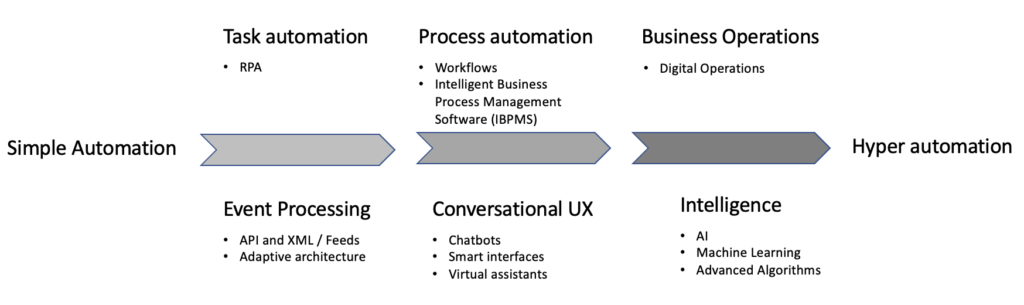
    In the service industry, hyperautomation can be used to automate a wide range of tasks, from customer service to supply chain management. For example, chatbots and virtual assistants can be used to provide quick and accurate responses to customer inquiries. Companies such as IBM Watson, Amazon Lex, and Google Dialogflow are examples of platforms that provide chatbot and virtual assistant capabilities. Similarly, machine learning algorithms can be used to optimize supply chain logistics. Companies such as Blue Yonder, Llamasoft, and Kinaxis provide solutions that use machine learning to optimize supply chain operations. Additionally, hyperautomation can be used to analyze large amounts of data, allowing organizations to gain valuable insights and make more informed decisions. Companies such as Alteryx, RapidMiner, and DataRobot provide solutions for data analysis and predictive modeling. One example of a project that uses hyperautomation in supply chain management is Walmart’s use of AI-powered robots to monitor and track inventory in their warehouses. Another example is the use of chatbot in banking industries such as Wells Fargo, which uses AI-powered chatbot to provide quick and accurate responses to customer inquiries.

    However, implementing hyperautomation in the service industry is not without its challenges. To prepare for hyperautomation, organizations need to take several basic steps. First, they need to assess their current automation capabilities and identify areas where they can benefit from hyperautomation. Second, they need to develop a clear strategy and governance structure for implementing hyperautomation. This should include clear guidelines for ethical use, data privacy, and security. Third, organizations need to invest in the necessary skills and resources to implement and manage hyperautomation. This may include hiring new staff with expertise in AI, ML, and RPA, or providing training to existing employees.

    In conclusion, hyperautomation is a powerful technology that has the potential to revolutionize the service industry. However, organizations need to take the necessary steps to prepare for it. This includes assessing their current automation capabilities, developing a clear strategy and governance structure, and investing in the necessary skills and resources.

    References:

  • E-commerce B2B outlook 2023

    E-commerce B2B outlook 2023

    E-commerce has come a long way since its inception and is continually evolving. In the coming year of 2023, we can expect to see a greater emphasis on personalization, convenience and user experience. One of the major trends that will gain momentum in 2023 is the use of artificial intelligence and machine learning in e-commerce. These technologies will be used to create more personalized shopping experiences for customers, with targeted product recommendations and customized search results. This will have a significant impact on web shop search engines, as they will need to adapt to these new technologies in order to remain competitive.

    Machine Learning

    As AI and machine learning continue to advance, e-commerce businesses will be able to gather more data on customer behavior and preferences, which will allow them to make even more accurate product recommendations. Additionally, AI-powered chatbots will become more common on e-commerce websites, providing customers with quick and efficient customer service.

    B2B to B2C

    Another trend that is likely to grow in 2023 is the blurring of the lines between B2B and B2C e-commerce. Business-to-business buyers are increasingly looking for the same convenient and user-friendly experiences that consumers have come to expect. This means that B2B e-commerce platforms will need to adopt more B2C-style interfaces, with easy-to-use navigation, intuitive product search, and a focus on customer service. This will allow B2B businesses to streamline their purchasing process and make it more efficient for their customers.

    B2C (business-to-consumer) and B2B (business-to-business) e-commerce have some similarities, but there are also significant differences in terms of the technologies that are used.

    In B2C e-commerce, the focus is on providing a personalized and convenient shopping experience for the consumer. As such, some of the most important technologies for B2C e-commerce include:

    • Personalization: Technologies such as artificial intelligence and machine learning are used to provide personalized product recommendations and customized search results based on a customer’s browsing history and purchase history.
    • Mobile optimization: With more and more people using their smartphones to shop online, it is essential for e-commerce websites to provide a seamless mobile experience. This includes responsive design, mobile-specific checkout processes, and mobile payment options.
    • Social media integration: Many B2C e-commerce businesses use social media platforms like Facebook, Instagram, and Pinterest to connect with customers and promote their products.
    • Marketing automation: Platforms like Hubspot, Marketo, and Pardot can be used to automate marketing tasks such as email marketing, social media advertising, and customer segmentation.
    • Customer service automation: Chatbots and virtual assistants can be used to provide quick and efficient customer service, answering common questions and helping customers navigate the website.

    In B2B e-commerce, the focus is on streamlining the purchasing process for businesses and providing a convenient and user-friendly experience. Some of the most important technologies for B2B e-commerce include:

    • ERP integration: B2B e-commerce platforms often integrate with enterprise resource planning (ERP) systems in order to streamline the purchasing process and make it more efficient for customers.
    • EDI integration: Electronic Data Interchange (EDI) is a standard format for electronic business transactions, which is often used in B2B e-commerce to automate order fulfillment and inventory management.
    • CRM integration: B2B e-commerce platforms often integrate with customer relationship management (CRM) systems in order to provide a more personalized shopping experience for businesses.
    • Procurement automation: Platforms like SAP Ariba and Oracle Procurement Cloud can be used to automate the purchasing process and make it more efficient for businesses.
    • Invoicing and payment automation: Platforms like Bill.com and Invoice2go can be used to automate invoicing and payment processes, making it easier for businesses to manage their finances.

    In conclusion, the trend of blurring the lines between B2B and B2C e-commerce is likely to grow in 2023, as business-to-business buyers are increasingly looking for the same convenient and user-friendly experiences that consumers have come to expect. This means that B2B e-commerce platforms will need to adopt more B2C-style interfaces, with easy-to-use navigation, intuitive product search, and a focus on customer service. This will allow B2B businesses to streamline their purchasing process and make it more efficient for their customers. The use of technologies such as AI, machine learning, ERP integration, EDI integration, CRM integration, procurement automation and invoicing and payment automation will help in achieving this. Businesses that are able to adapt to these trends will be well-positioned to remain competitive in the e-commerce industry.

    Mobile

    In terms of user experience, we can expect to see a greater emphasis on mobile optimization in 2023. With more and more people using their smartphones to shop online, it will be essential for e-commerce websites to provide a seamless mobile experience in order to stay competitive. This will also likely involve the use of augmented reality and other immersive technologies to enhance the shopping experience on mobile devices. Augmented reality allows customers to see how a product will look in their home before they make a purchase, which can be a valuable tool in the e-commerce industry.

    Mobile B2B e-commerce has become increasingly important as business buyers are utilizing their mobile devices for researching and purchasing products. A responsive design is essential for mobile B2B e-commerce as it allows for an optimal user experience, regardless of the screen size or resolution of the device being used.

    A study by Forrester Research found that 72% of B2B buyers research products on their mobile devices before making a purchase. This means that a responsive design is crucial for B2B e-commerce, as it allows for easy navigation and access to information on mobile devices, which can improve the chances of a sale. A non-responsive design can lead to a poor user experience and a loss of potential sales.

    In addition to improving user experience, a responsive design also has several other benefits. It can improve search engine optimization (SEO) by making it easier for search engines to crawl and index the website, it can also improve the site’s security, and it can help to maintain consistency of the brand across all platforms.

    Therefore, responsive design is a crucial aspect for mobile B2B e-commerce. It improves user experience, increases the chances of a sale and improves overall website performance.

    Conclusion

    To sum up, 2023 will be a year of significant changes in e-commerce. The use of AI, machine learning and other technologies will revolutionize the way we shop online, and B2B e-commerce will adopt more B2C type interfacing to provide a seamless user experience. Businesses will have to adapt to these trends in order to stay competitive in the e-commerce industry.

    References:

  • Digitalisation of customer service

    Digitalisation of customer service

    Digitalisation has changed the way customer service organisations operate, enabling them to automate processes and improve customer interactions. One way to achieve this is by implementing e-mail parsing and generation, which can help companies to better understand customer needs and respond more efficiently.

    E-mail parsing is the process of automatically extracting information from incoming e-mails. This can include data such as customer names, order numbers, and specific requests. E-mail generation, on the other hand, is the process of automatically creating e-mails based on pre-written templates and specific customer information. Together, these two techniques can help companies to quickly and accurately respond to customer inquiries, reducing response times and improving overall customer satisfaction.

    There are several benefits to implementing e-mail parsing and generation in customer service organisations. One of the main benefits is that it can significantly reduce response times. According to a study by McKinsey, companies that have implemented automation in their customer service processes have seen a 20-30% reduction in response times (1). This is because automated e-mail responses can be sent almost immediately, without the need for a human customer service representative to manually respond.

    Another benefit of e-mail parsing and generation is that it can increase efficiency. By automating repetitive tasks, such as responding to common customer inquiries, companies can free up their customer service representatives to focus on more complex tasks. This can lead to more efficient use of resources and a higher level of productivity. According to a study by Accenture, companies that have implemented automation in their customer service processes have seen a 20-30% increase in efficiency (2).

    In addition to reducing response times and increasing efficiency, e-mail parsing and generation can also improve customer satisfaction. By providing customers with quick and accurate responses, companies can help to build trust and loyalty. A study by Forrester Research found that companies that have implemented automation in their customer service processes have seen a 15-20% increase in customer satisfaction (3).

    Implementing e-mail parsing and generation in a customer service organisation can be relatively simple. One way to get started is by using e-mail parsing software, such as Clearbit or Parsey, to extract customer information from incoming e-mails. This information can then be used to automatically generate responses using e-mail generation software, such as Boomerang or Mixmax. Companies can also use pre-written templates to ensure that all responses are consistent and accurate.

    Another way to implement e-mail parsing and generation is by using a customer service platform, such as Zendesk or Salesforce Service Cloud. These platforms often include built-in e-mail parsing and generation features, making it easy for companies to get started. In addition, these platforms often include other customer service automation features, such as chatbots and ticket management, that can help companies to improve their customer service processes even further.

    In conclusion, e-mail parsing and generation can significantly improve customer service organisations by reducing response times, increasing efficiency, and improving customer satisfaction. Companies can easily implement this form of digitisation by using e-mail parsing software, e-mail generation software, or customer service platforms. As digitalisation continues to evolve, we can expect to see even more advanced forms of automation, such as natural language processing and machine learning, that will further improve customer service processes and customer satisfaction.

    References

    McKinsey. (2019). The future of customer service: Four trends to watch. Retrieved from https://www.mckinsey.com/industries/high-tech/our-insights/the-future-of-customer-service-four-trends-to-watch

    Accenture. (2019). The future of customer service: How automation is transforming the customer experience. Retrieved from https://www.accenture.com/us-en/insights/customer-service/customer-service-automation

    Forrester Research. (2018). The future of customer service: How automation will change the game. Retrieved from https://www.forrester.com/report/The+Future+Of+Customer+Service+How+Automation+Will+Change+The+Game/-/E-RES146962